

Translations [PDF]
- Principles
- Roles
- Processes & Events
- Artifacts & Reports
- Domains and Policies
- Practices Collection
- Æilus as a Formalization
- Evolution of Æilus
Æilus is a methodology for deliberate work with value in complex socio-economic systems. It is built on top of the Theory of Value Management (VMT) and translates theoretical concepts into repeatable, observable, and safe ways of acting.
If VMT explains how value behaves, Æilus explains how to work with value without breaking the system.
What the Æilus Methodology is
Æilus is not a set of tools, templates, or universal best practices.
It is a methodological layer that defines:
- how value systems are identified and bounded;
- how value flows are made explicit and observable;
- how interpretations of value are synchronized;
- how resistance and anti-value are detected and reduced;
- how system stability is preserved under change.
Æilus is intentionally non-prescriptive. It does not tell you what decisions to make. It defines how decisions should be reasoned about.
The Aeilus methodology is built around the idea of presenting the movement of assets (tangible and intangible) and services within one business as the movement of a single value stream. All values in such a stream are measured with one type of measure (Value Points).
The business owner, in addition to the role of manager and leader, gets the value stream owner role. He designs the value stream, defines the value for the stream, determines how value is created, and ensures that the stream is launched.
The Aeilus approach is applicable to other value systems, such as the state or the individual.
Cyclic value systems are able to transfer value from one system participant to another in a circle. At the same time, at each stage, the value can be represented in various forms. Each participant in the system consumes a certain value and transforms and produces a new value. Each participant inside has a value system. Moreover, a negative value (Anti-value) can be returned back to the flow.
In Aeilus, a participant in the value system is called a Transformer since he transforms the value, while the value stream can be increased or decreased (in measured value points).
Let's see what the cyclical value system of the state looks like
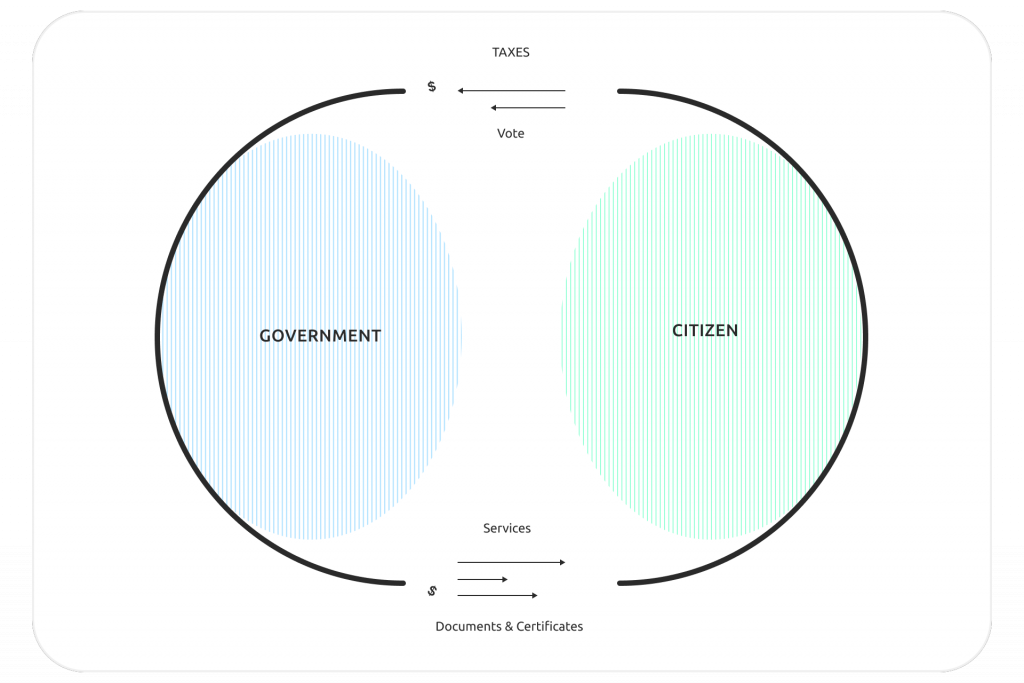
Let's compare it with business and take a closer look at the relationship between the Company and the Clients.
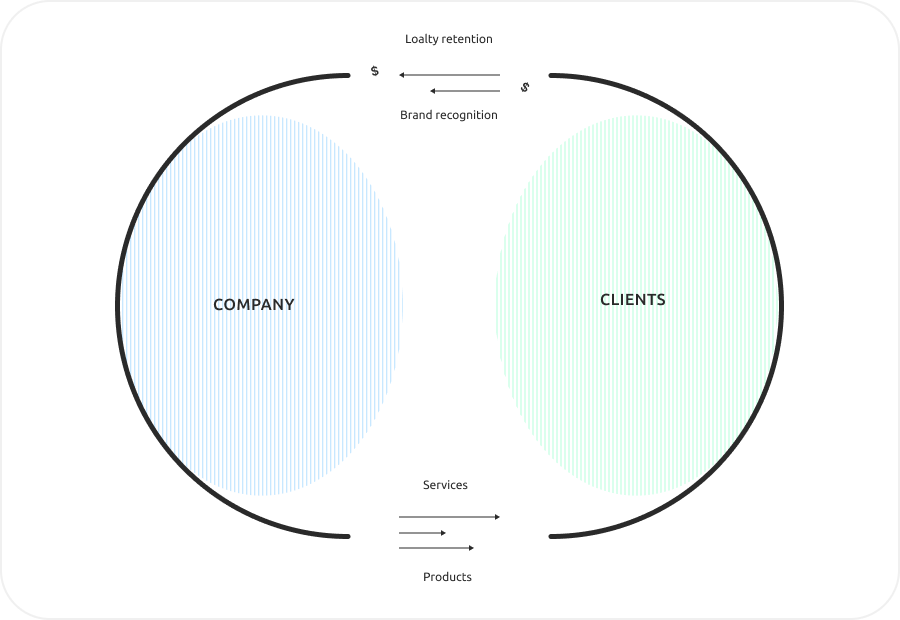
By diving deeper into the "Company" transformer, we can imagine our value system inside. This is a set of units that exchange value with each other. Holding companies can be divided into business units or projects, and a division can generate value for different streams.
Every department must understand that all of their activities are subject to the cycle of value that we saw in the previous stage Company/Customers. Everything else is considered a loss of value in the system.
Principles
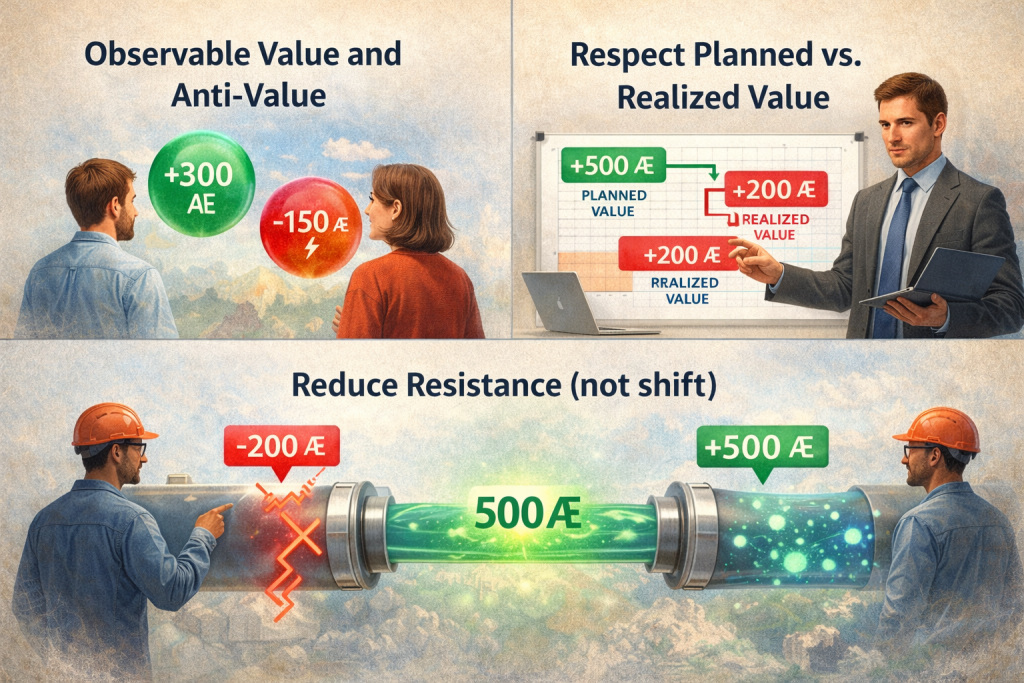
The methodology is grounded in a small set of principles derived directly from VMT. These principles ensure that any intervention:
- is based on observable value and anti-value;
- respects the asymmetry between planned and realized value;
- reduces flow resistance rather than shifting it elsewhere;
- preserves participation conditions for all actors.
Principles act as guardrails. They do not provide answers, but they prevent destructive actions.
Roles
Æilus assigns clear ownership to different aspects of the value system. Roles are defined to ensure accountability without centralizing control.
- Value System Owner - responsible for system sustainability.
- Value Transformer Owner - responsible for value production and practices.
- Flow Owner - responsible for value delivery between actors.
- Domain Owner - responsible for system constraints and policies.
- Æilus Master - responsible for correct application of the methodology.
Roles are functional, not hierarchical. They exist to make value dynamics manageable.
Processes and Events
Æilus operates through recurring processes and events rather than one-time transformations.
These include:
- value system modeling and review;
- interpretation alignment sessions;
- flow and resistance analysis;
- practice selection and validation;
- retrospective value analysis.
Processes ensure that value remains observable over time, not just at decision points.
Artifacts and Reports
To avoid value discussions becoming purely verbal, Æilus relies on explicit artifacts.
Artifacts capture:
- value system schemas;
- value elements and their types;
- flow structures and resistance points;
- planned vs. realized value gaps;
- anti-value accumulation.
Reports make these artifacts actionable by revealing trends rather than snapshots.
Domains and Policies
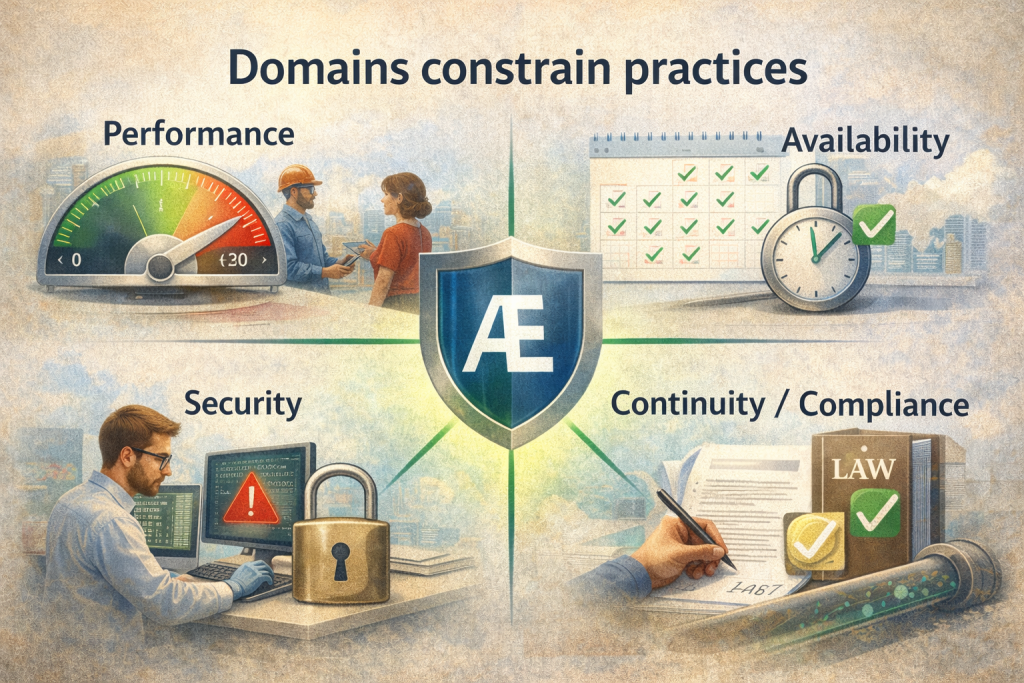
Value is never delivered in isolation. It is always constrained by quality contexts such as performance, availability, security, continuity, or compliance.
Æilus formalizes these contexts as Domains.
Domains define policies that practices must respect to prevent:
- hidden anti-value;
- loss of trust;
- violation of participation conditions;
- system instability.
Practices Collection
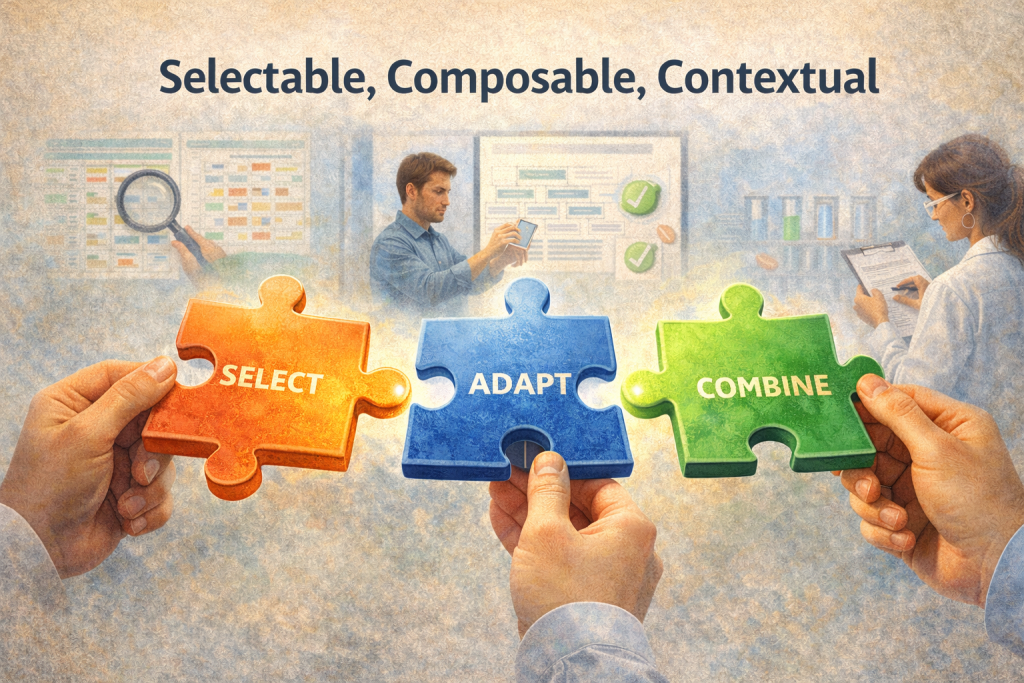
Practices are reusable patterns of work with explicit inputs and outputs. They are selected, adapted, and combined by transformer owners.
In Æilus, practices are:
- composable (only when interfaces are clear);
- context-dependent;
- subject to validation and retirement.
Practices are accumulated, studied, and curated through research work rather than assumed to be universally good.
Æilus as a formalization
Æilus deliberately avoids becoming a fashionable framework.
It is a formalization layer that:
- connects theory to practice;
- limits arbitrary interpretation;
- allows comparison between systems and interventions;
- supports falsification and learning.
Evolution of Æilus
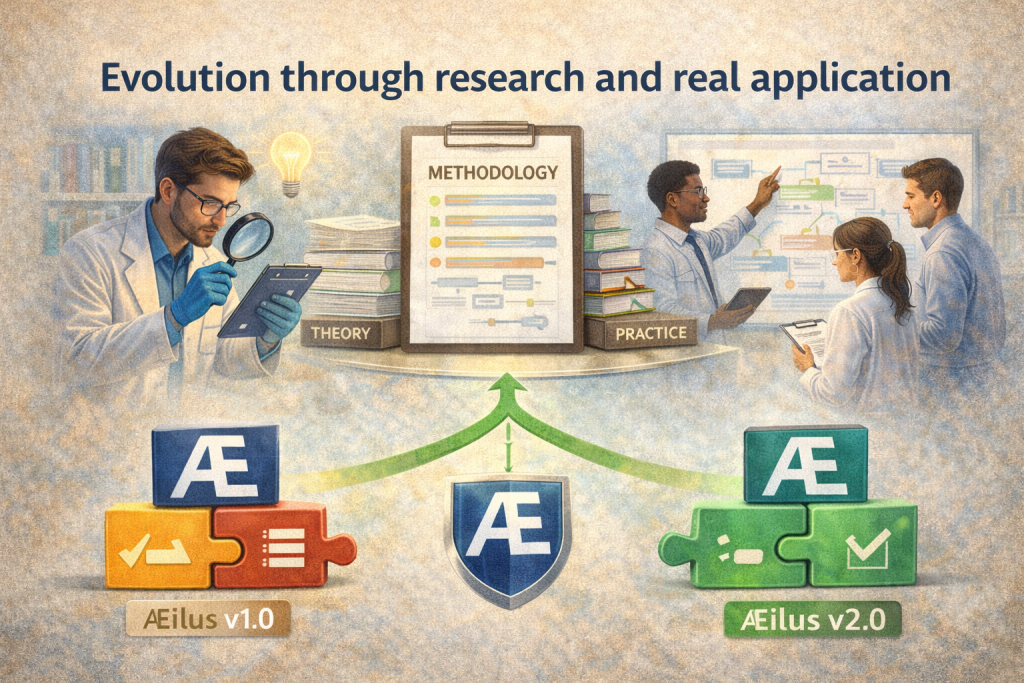
Æilus has evolved through real application, critique, and refinement.
Version 2.0 reflects:
- clear separation between theory, methodology, and practice;
- explicit roles and ownership models;
- formal domains and policies;
- research-driven accumulation of practices.
Evolution is treated as a controlled process, not as feature expansion.
Æilus is not about managing people or processes. It is about managing value dynamics without destroying the systems that produce them.
License: The Æilus methodology may be used and shared freely. Redistribution requires attribution with a link to https://aeilus.tech.