

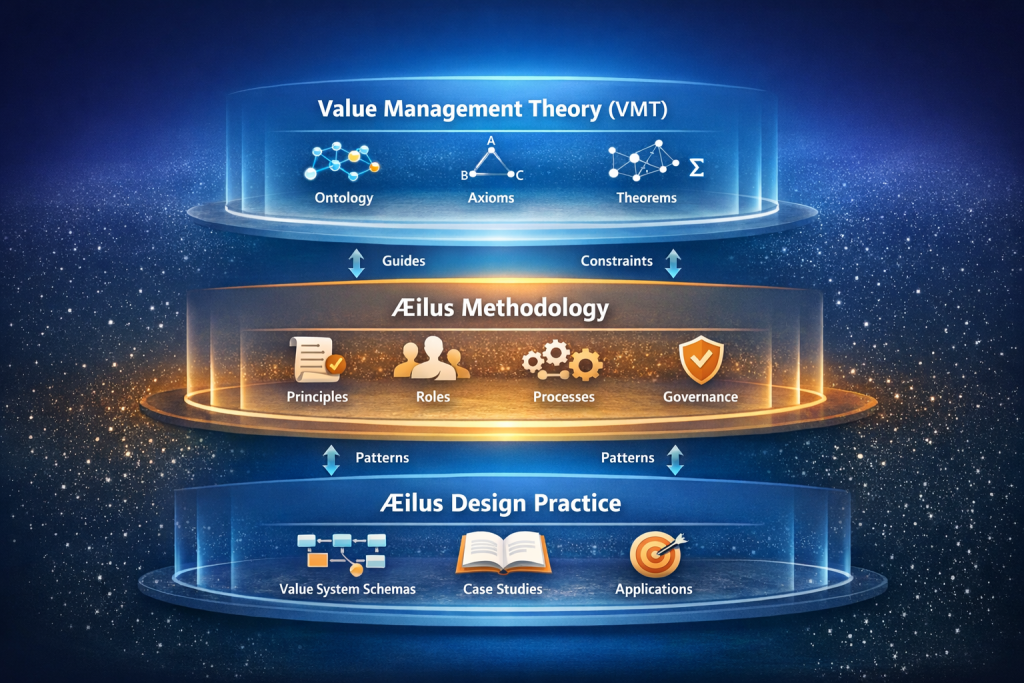
Value exchanges exist in every organization and every product ecosystem - whether anyone manages them or not. Time, effort, attention, expectations, outcomes, trust, reliability, risk, and money continuously move between actors and systems.
This page explains the theoretical foundation behind Æilus: the Value Management Theory (VMT). It provides a practical, detailed overview of how VMT is structured and what it formalizes - so you can understand the theoretical layer without leaving aeilus.tech.
How VMT is structured
VMT is organized as a scientific theory with four core components:
- Ontology - the minimal set of concepts used by the theory.
- Axioms - foundational statements assumed within the theory.
- Theorems - derived consequences that describe system-level effects.
- Applicability & Falsifiability - explicit limits and ways the theory can be critically tested.
In other words, VMT is not a “framework” or “best practices list”. It is a descriptive theory intended to explain how value and anti-value behave in socio-economic systems.
Ontology: the building blocks of value systems
VMT begins by defining what a value system is and what must exist for the concept to be meaningful. A value system requires at least:
- two or more actors,
- and at least two directed flows enabling reciprocal interaction (not necessarily symmetric).
Within such a system, VMT defines the following core concepts:
Actor
An actor is an entity capable of interpreting changes in its state as “better” or “worse” with respect to some criteria. Actors may produce value for others, consume value, or both. In a given analysis, an actor’s value production outside the system may be intentionally left out of scope.
Value Element
A value element is an abstract carrier of value or anti-value. It can describe properties of physical objects, actions, services, or abstract objects (e.g., risk, obligation, knowledge, trust). Elements may be typed if distinguishing types is necessary to interpret flows consistently.
Flow
A flow is a directed interaction between exactly two actors (sender and recipient) where value elements are transferred. A flow always has a sender and a recipient, and it may connect internal or external actors relative to the analyzed value system.
Value is interpreted: planned, realized, retrospective
A defining feature of VMT is that value is not treated as a universal scalar. Value exists only through interpretation by actors within a value system.
VMT distinguishes multiple forms of value interpretation:
- Potential value (Vpotential) - value that exists as a capability before a recipient is defined and before a delivery flow is organized.
- Planned value (Vplan) - the sender’s interpretation of expected impact once a recipient and a delivery flow are defined.
- Realized value (Vreal) - the recipient’s interpretation formed at the moment of consumption, as an actual ordered change of state.
- Retrospective value (Vretro) - the recipient’s later re-evaluation of previously realized value, caused by feedback from subsequent flows (when the recipient tries to use the value further and learns that the earlier interpretation was incomplete or wrong).
VMT treats anti-value as an independent category (not “zero value”). Anti-value also has planned, realized, and retrospective forms.
Realization, transformation, and storage
Realization
A flow ends at consumption: this is where realized value (or realized anti-value) becomes defined. Realization may lead to consumption, transfer into other systems, or transformation into new elements.
Transformation as a role (not an entity)
In VMT, a “transformer” is not a separate object. It is a role an actor plays when it produces new value elements (or anti-value elements) after realizing incoming value. Multiple actors may share the same transformation role, enabling redundancy and scalability.
Storage
Actors may accumulate stored value. Storage is not “free”: it consumes value to maintain, and it increases the time gap between creation and consumption. Long storage increases the risk of divergence between planned and realized value, and therefore requires re-evaluation before sending value into a flow.
Resistance: why value degrades in flows
VMT introduces flow resistance to describe why value does not arrive as expected. Resistance includes:
- the gap between planned and realized value,
- realized anti-value produced along the way,
- and “undelivered value” - value that was created and sent but never reached the recipient (e.g., delays, blocking, loss of context, forgotten deliverables).
Resistance is often historical: anti-value and persistent expectation gaps can accumulate and increase resistance over time.
Participation and system sustainability
VMT formalizes why systems remain stable or collapse using the concept of participation conditions. Each actor has thresholds that determine whether participation remains acceptable over a time horizon:
- minimum acceptable realized value,
- maximum acceptable realized anti-value,
- and the actor’s ability to produce value that is demanded by others (i.e., the ability to send planned value into active flows).
A value system is sustainable if and only if participation conditions hold for all actors on the chosen time horizon.
Multiple value systems and inter-system effects
VMT explicitly allows the existence of multiple value systems for the same empirical reality: changing criteria and boundaries changes what is interpreted as value. There is no universal value independent of the system context.
Systems interact only through external flows. VMT describes:
- inflows (value entering from external systems),
- outflows (value leaving to external systems),
- value leakage as a persistent imbalance between them.
What the theorems capture (intuitively)
From this structure, VMT derives system-level consequences, such as:
- “value in general” is not meaningful without a specified value system,
- planned and realized value are structurally asymmetric,
- local optimization does not guarantee system-level improvement,
- accumulation of anti-value and expectation gaps increases resistance and reduces future realizability,
- systems depend on stable roles and deliverability of flows to remain sustainable,
- hidden or latent flows are implied when observed flows cannot explain sustainability,
- inter-system inflows/outflows create structural dependence.
Limits and falsifiability
VMT is intentionally explicit about what it does not do: it does not derive prices, does not provide normative welfare rankings, and does not replace economic theory. It provides a descriptive layer that can coexist with many economic models.
VMT is falsifiable in several ways:
- logical falsification: contradictions inside the definitions and axioms,
- empirical falsification: if, under a clearly specified value system, key derived properties (e.g., structural asymmetry) consistently fail,
- methodological clarity: separating refutation of the theory from refutation of a specific system boundary or measurement proxy.
Relation to Æilus
VMT explains how value behaves. Æilus is the methodology that operationalizes this theory for real systems: principles, roles, processes, domains, and practices that enable deliberate interventions without destroying system stability.
If you want a theory-first onboarding path, start here: Welcome →
If you want the canonical public presentation of VMT in a structured and multilingual format, see: https://value-management.science/