

Æilus works with complex value systems. Such systems cannot be improved through centralized control or informal responsibility alone.
To make value dynamics manageable without destroying system stability, Æilus introduces a set of functional roles. These roles define responsibility and ownership in relation to value - not hierarchy or authority.
Why roles are necessary
In many organizations, responsibility for value is implicit, fragmented, or shifted between actors. As a result:
- value production and value delivery are mixed;
- no one owns flow resistance and anti-value;
- system-level problems are addressed through local optimization;
- decisions improve metrics but harm sustainability.
Æilus roles exist to prevent these failure modes. They make responsibility explicit while preserving distributed decision-making.
Roles are functional, not hierarchical
An Æilus role is defined by the function it performs in the value system, not by position in an organizational chart.
The same person may hold multiple roles. Multiple people may share the same role. Roles may change over time as the system evolves.
What matters is not who holds a role, but which responsibility is covered.
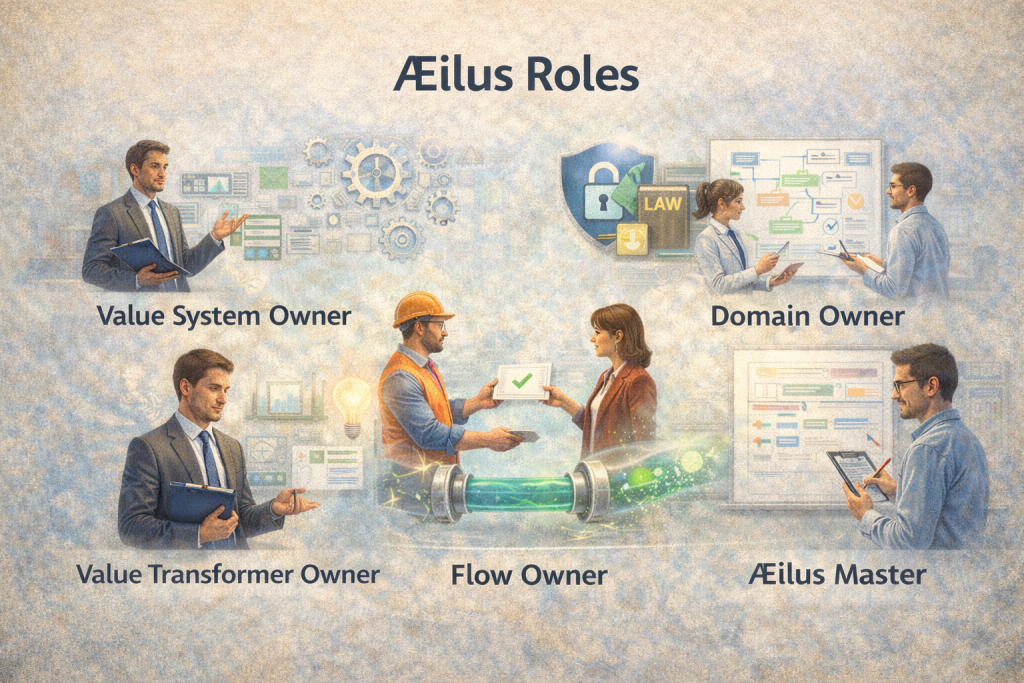
Role model overview
| Role | Type | When it is needed |
|---|---|---|
| Value Transformer Owner (VTO) | Core | Always |
| Value System Owner (VSO) | Core | Always |
| Flow Owner | Scaling | Complex / critical flows |
| Practice Owner | Scaling | Shared / critical practices |
| Domain Owner | Scaling | Critical non-functional constraints |
| Æilus Master | Support | Adoption / maturity growth |
Core roles
Value Transformer Owner (VTO)
The Value Transformer Owner is responsible for the capability of a specific transformer to sustainably realize and transform value within a value system. This role exists so that each transformer has an explicit subject of responsibility for:
- actually delivered (realized) value;
- anti-value that emerges as a by-product;
- the transformer’s ability to continue participation without degradation.
Without this role, a transformer tends to:
- accumulate anti-value,
- lose delivery capability,
- inflate planned value,
- erode trust at system boundaries.
Scope of responsibility
- realized and retrospectively re-evaluated value produced in the transformer;
- anti-value and resistance created by the transformer;
- the ability to turn potential value into planned value, and planned value into realized value;
- selection and replacement of practices used for value transformation;
- compliance with domain policies and the transformer’s participation conditions.
Not responsible for
- overall sustainability of the entire value system;
- value produced by other transformers;
- centralized enforcement of practices;
- making decisions on behalf of other transformer owners.
Principled position
The VTO is not obliged to constantly increase planned value. The obligation is to:
- increase realized value,
- reduce anti-value and resistance,
- and increase planned value only when such growth is justified (demand exists, inflow exists, delivery capability is confirmed, and participation/sustainability are not violated).
Value System Owner (VSO)
The Value System Owner is responsible for the sustainability, integrity, and reproducibility of the value system as a whole. This role exists so that the system:
- remains capable of delivering value under changing conditions;
- does not collapse due to local optimization of individual transformers;
- keeps interpretations aligned across actors and transformers;
- does not lose actors due to unnoticed violations of participation conditions.
Scope of responsibility
- sustainability of the value system as a whole;
- system configuration (boundaries, actors, roles, critical flows);
- coherence of value interpretations between transformers;
- system-level participation conditions and their violations;
- deliverability of value through critical flows;
- system-level anti-value and persistent outflows to external systems;
- balance between growth of planned value and system sustainability.
Not responsible for
- internal value realization inside a specific transformer;
- selection of transformer-internal practices;
- operational efficiency of individual teams;
- local decisions that do not affect system sustainability.
Value Aggregation Policy ownership
The Value System Owner (VSO) is responsible for maintaining the system’s value aggregation policy: how multi-domain value is compared, aggregated, and traded off when value types are only partially commensurable. Without an explicit aggregation policy, system decisions drift into implicit assumptions and unstable interpretations.
Principled position
The VSO does not pursue maximization of planned value at any cost. The obligation is to ensure that:
- growth of planned value is justified,
- system-level delivery capability remains viable,
- participation conditions are not violated,
- the system remains stable over time.
Scaling and support roles
Flow Owner
The Flow Owner is introduced when interaction between transformers becomes a persistent source of anti-value or resistance. The role does not manage transformers; it manages the space between them, where value is often lost and interpretations diverge.
When it is justified
- delivery requires a sequence of connected flows across multiple transformers;
- resistance is localized between transformers (not inside them);
- planned and realized interpretations diverge systematically;
- the flow is critical for system sustainability;
- delivery is unstable or frequently interrupted.
Scope of responsibility
- alignment of interpretations between flow participants;
- identification and reduction of flow resistance;
- visibility of accumulation and losses along the flow;
- facilitation of agreements between VTOs.
The Flow Owner rarely increases delivered value directly, but restores its realizability by reducing resistance.
Interpretation drift responsibility
Flow Owners and Domain Owners share responsibility for preventing interpretation drift: sustained divergence between planned, realized, and retrospective value. Their role is not to enforce consensus, but to keep interpretations verifiable through consequence-based confirmation and to reduce resistance at interfaces where value is frequently lost or reinterpreted.
Practice Owner
The Practice Owner is responsible for the integrity, admissibility, and reproducibility of a practice across transformers. The role exists so that a practice:
- preserves its intended design,
- is adapted without losing core meaning,
- does not degrade into a ritual or imitation,
- does not create systemic anti-value when scaled.
Scope of responsibility
- formal description of the practice (goal, inputs/outputs, intended effects);
- correct implementation and adaptation across transformers;
- compatibility with domain policies;
- detection of anti-value caused by distorted implementations;
- decision to revise or decommission the practice when necessary.
The Practice Owner does not own transformer results; the role owns the practice design and correctness of its application.
Domain Owner
The Domain Owner is responsible for correct interpretation of value under a specific context (domain) and for preventing systemic anti-value caused by ignoring that context. Domains represent constraints such as availability, security, reliability, continuity, architecture, knowledge management, continuous improvement, and others.
Scope of responsibility
- definition and maintenance of domain policies;
- assessment of practices and processes against domain requirements;
- detection of systemic anti-value caused by domain violations;
- early escalation of domain risks threatening sustainability.
The Domain Owner does not “produce value”; the role protects the system from non-admissible anti-value.
Æilus Master
The Æilus Master is responsible for correct understanding, application, and evolution of Æilus within a specific value system. The role exists so that Æilus is applied as a methodology, not as rituals, and does not drift away from VMT.
Scope of responsibility
- methodological integrity of Æilus principles in the given context;
- detection of methodological distortions and cargo-cult adoption;
- support for VTO/VSO/Flow/Domain/Practice owners in complex methodological questions;
- facilitation of key Æilus events (interpretation alignment, value retrospectives);
- consistency between VMT and the practical application of Æilus.
The Æilus Master does not manage value production; the role manages correctness of how the methodology is applied.