

Æilus is not implemented as a one-time transformation. It is implemented as a set of recurring processes and events that keep a value system observable, coherent, and sustainable over time.
In VMT terms, value is dynamic: interpretations drift, resistance accumulates, anti-value emerges, and external dependencies change. Æilus processes exist to ensure that the system reacts to these dynamics deliberately rather than accidentally.
What Æilus processes are
Æilus processes are regular loops of observation, analysis, and adaptation. They operationalize the principles of Æilus by forcing the system to repeatedly answer four questions:
- What value and anti-value are moving through the system right now? (observability)
- How do planned, realized, and retrospective interpretations differ? (alignment)
- Where does resistance grow and why? (resistance reduction)
- Are participation conditions and system sustainability still satisfied? (stability)
Processes do not prescribe which practices to use. They create a disciplined environment in which practices can be selected, validated, replaced, or retired based on real system behavior.
What Æilus events are
Events are the human and organizational “activation points” of the methodology. They exist to synchronize interpretations, validate delivery, and make system-level signals explicit.
Without events, value work becomes invisible again and reverts to informal opinions and local optimization.
Core operating cycle
A mature Æilus implementation typically runs a repeating operating cycle with four layers:
- Observe - maintain visibility of value elements, anti-value, and accumulation.
- Align - synchronize interpretations between senders and recipients.
- Intervene - select or adjust practices to reduce resistance and improve realized value.
- Stabilize - ensure participation conditions and domain policies remain satisfied.
This cycle is continuous: the system never reaches a final “optimized” state. It becomes more reproducible and less fragile.
Mandatory process groups
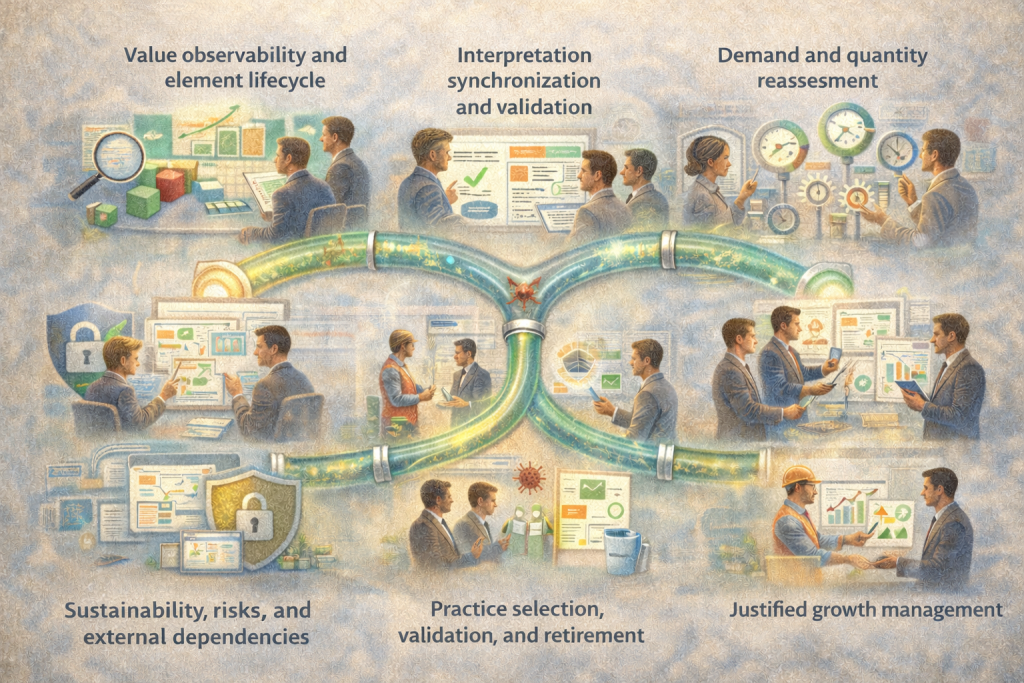
1) Value observability and element lifecycle
Implements Principle P1 (observability) and supports P5 (throughput over accumulation).
- Identify and track significant value and anti-value elements.
- Maintain element typology and clarify which elements matter in this system.
- Monitor accumulation of elements inside transformers (including long-held planned value).
- Ensure stored planned value is re-evaluated before entering a flow.
2) Interpretation synchronization and validation
Implements Principles P2 and P10 (alignment and integrity of interpretations).
- Compare planned vs realized vs retrospective value interpretations.
- Make interpretation criteria explicit and discussable.
- Validate realized value with the receiving actor.
- Detect manipulation risks: inflation of Vplan or deflation of Vreal for local advantage.
3) Demand and quantity reassessment
Implements Principle P3 (demand for elements).
- Reassess which element types are needed and in what quantity.
- Detect overproduction and undersupply.
- Ensure that produced value has a viable recipient and a deliverable flow.
4) Sustainability, risks, and external dependencies
Implements Principle P4 (sustainability and participation conditions).
- Monitor participation conditions for critical actors and transformers.
- Track system dependence on external inflows/outflows.
- Identify leakage patterns and structural fragility.
- Decide when the system needs stabilization instead of growth.
5) Resistance and anti-value reduction
Implements Principle P6 (reducing resistance).
- Analyze resistance drivers: gaps between Vplan and Vreal, anti-value, undelivered value.
- Locate resistance at boundaries (between transformers) and inside transformers.
- Prioritize interventions that reduce resistance rather than shift it elsewhere.
6) Practice selection, validation, and retirement
Implements Principles P7 and P8 (efficiency and system priority).
- Select practices based on realized value per consumed value.
- Prefer practices that increase transformer/system capability rather than local output.
- Validate practices through observable effects on resistance, anti-value, and stability.
- Retire practices that degrade domain properties or create systemic anti-value.
7) Justified growth management
Implements Principle P9 (justified growth of planned value).
- Confirm demand for increased value inside the system.
- Confirm sufficient inflow and production capacity.
- Confirm deliverability of realized value.
- Ensure participation conditions and system sustainability are not violated.
8) Interpretation Validation
This process group verifies that changes in value interpretation are confirmed through observable consequences of value realization. It is designed to detect interpretational distortion - cases where planned value narratives change without corresponding improvements in realized or retrospective value.
- Compare planned vs realized vs retrospective value interpretations for key flows.
- Identify interpretation shifts driven by external influence rather than realization outcomes.
- Trigger practice review and domain policy checks when interpretation drift persists.
Recommended events (minimum set)
Æilus does not mandate a single calendar, but a minimal sustainable implementation typically includes:
- Value System Review - revisit system boundaries, critical actors, key flows, dependencies.
- Interpretation Alignment Session - synchronize planned/realized/retrospective interpretations across a critical flow.
- Flow Resistance Review - identify bottlenecks, undelivered value, resistance accumulation points.
- Practice Review Board - evaluate which practices to adopt, adapt, or retire based on observed effects.
- Value Retrospective - analyze retrospective value to improve future interpretations and decisions.
The frequency of these events depends on system dynamics: fast-changing systems require shorter cycles; stable systems can use longer cycles.
Role ownership of processes
Processes are owned, not "performed by everyone". The role model defines who is accountable for keeping each loop alive:
- VTO owns transformer-internal observability, practice selection, and reduction of locally generated anti-value.
- VSO owns system-level sustainability, system configuration, and balance between growth and stability.
- Flow Owner (if introduced) owns resistance and interpretation alignment between transformers on complex flows.
- Domain Owner (if introduced) owns domain policies and prevents anti-value caused by domain violations.
- Practice Owner (if introduced) owns correctness and integrity of a practice across transformers.
- Æilus Master supports methodological integrity and prevents cargo-cult adoption.
What "good operation" looks like
A healthy Æilus operating model has three visible outcomes:
- Interpretations remain synchronized - planned value does not drift away from realized value unnoticed.
- Resistance decreases over time - anti-value and undelivered value do not accumulate silently.
- Sustainability is preserved - participation conditions are respected and the system remains stable under change.
Next: Artifacts and Reports — making value systems observable and decision-ready.