

In Æilus, practices are not “best practices” and are not prescribed to transformers by default.
Practices are treated as formalized local value systems inside a transformer - the way a transformer realizes and transforms incoming value.
If a transformer is not a single human but an organizational unit (a team, department, service, function), it inevitably has its own internal value system implemented through processes. In Æilus, such processes are described as practices.
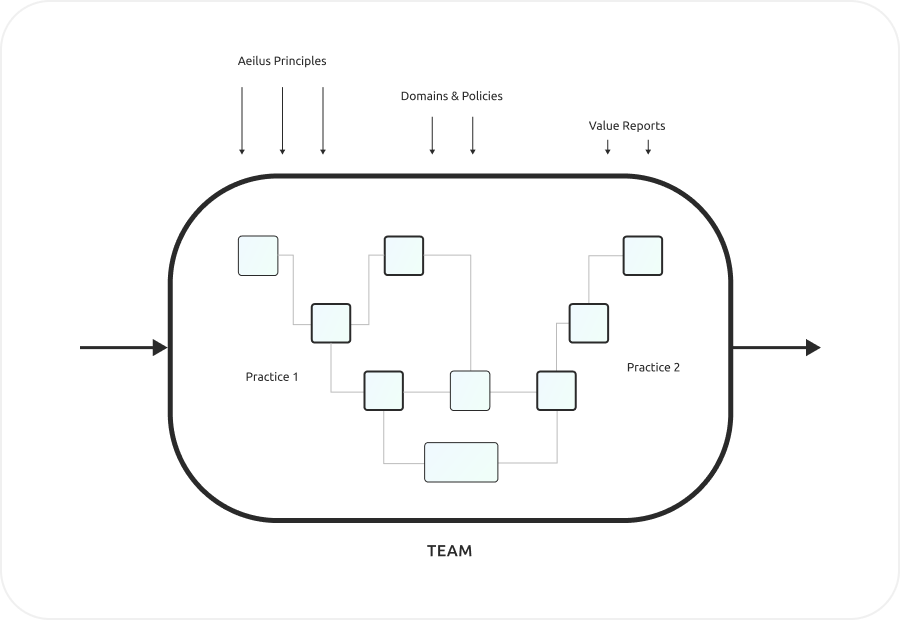
Definition: Practice
A Practice is a formal template of a local value system inside a transformer that defines:
- incoming elements of value and anti-value,
- how these elements are realized, transformed, or stored,
- outgoing elements of value and anti-value,
- conditions of admissibility of the practice in a value system.
A practice does not describe “how to do things correctly” in the abstract. It describes what value it consumes and what value it produces under defined conditions.
Why “best practices” do not exist
Æilus treats practices as local value systems, not universal prescriptions. A practice is admissible only in a specific value context and only while it produces observable system-level effects. A practice can be locally efficient and still create system anti-value through domain violations, interpretation drift, or increased flow resistance.
Practices and the value lifecycle
Practices in Æilus operate with all forms of value defined in VMT:
- Vpotential - opportunities and possibilities not yet directed to a recipient and a flow,
- Vplan - value for which a recipient is chosen and a flow is organized,
- Vreal - value that emerges at consumption,
- Vretro - later re-evaluation of previously realized value.
A practice may:
- transform Vpotential into Vplan (e.g., discovery practices),
- realize and transform Vplan (delivery practices),
- reduce anti-value and flow resistance,
- increase the transformer’s capability to deliver value sustainably.
Practice interfaces: inputs and outputs
To ensure composability and manageability, every practice in Æilus must have explicitly described interfaces:
- incoming elements of value and anti-value,
- outgoing elements of value and anti-value,
- expected effects on flow resistance and participation conditions.
Practices may be combined into processes only when their inputs and outputs are compatible.
Even if two practices are individually admissible, they must not be combined if their interfaces do not connect coherently. Incompatible practices produce anti-value through misalignment, duplication, or hidden resistance.
Consequence-based admissibility
A practice must not be evaluated solely by declared intent, perceived usefulness, or improved narratives. Practice admissibility in Æilus requires confirmation through observable consequences of value realization (e.g., reduced resistance, reduced anti-value, improved realized outcomes).
Practices that primarily increase planned value narratives or stakeholder enthusiasm without improving realized or retrospective value are treated as potential sources of interpretational distortion and should be reviewed or decommissioned.
Practice catalogue and the role of ÆVRI
Æilus assumes the accumulation and development of a practice catalogue through the Æilus Value Research Institute (ÆVRI).
The practice catalogue:
- is not a list of universal solutions,
- is a repository of validated local value systems (practices),
- documents context of applicability, effects, and constraints.
Adding a practice to the catalogue does not make it universally admissible.
Admissibility is always determined by:
- the specific value system context,
- domain policies of the transformer,
- participation conditions and sustainability constraints.
Responsibility for practice selection
Selection, replacement, and composition of practices is the responsibility of the Value Transformer Owner (VTO).
The VTO:
- builds transformer processes by selecting practices from the catalogue,
- adapts and replaces practices to improve realized value,
- is responsible for anti-value and resistance produced by practice usage,
- must respect domain policies and transformer participation conditions.
Practices are not centrally imposed and are not enforced externally. In Æilus, a practice is valid only when it is justified by system effects and remains admissible under domain constraints.
Terminal vs instrumental outcomes
When selecting practices, Æilus distinguishes between instrumental outcomes (internal artifacts and intermediate improvements) and terminal outcomes (value realized at consumption points). Practices that optimize instrumental outputs while failing to improve terminal realization typically increase accumulation and resistance across the system.