

Æilus requires value work to be observable, comparable, and discussable. Without artifacts, value discussions quickly degrade into opinions and local narratives.
Artifacts in Æilus are not documentation “for its own sake”. They exist to implement the core principles: observability of value elements (P1), alignment of interpretations (P2), resistance reduction (P6), and integrity of interpretations (P10).
What artifacts are in Æilus
An artifact is a structured representation of a part of the value system. Artifacts make implicit knowledge explicit:
- what elements of value and anti-value exist,
- where they move,
- where they accumulate,
- how they are interpreted by different actors,
- where resistance and anti-value emerge.
In Æilus, artifacts are decision instruments. If an artifact does not support decisions, it is not a valid artifact in practice.
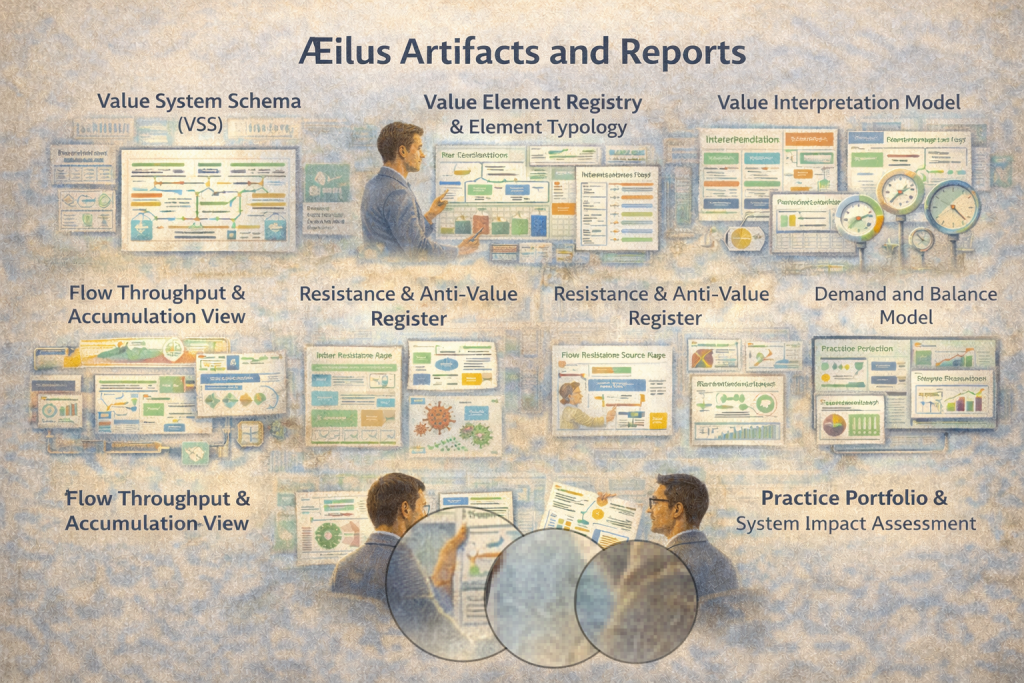
Core artifact groups
1) Value System Schema (VSS)
A VSS is a formal description of the value system: actors, flows, transformers, and key exchanges. It is used to establish system boundaries and to prevent “invisible” external dependencies.
VSS can exist at multiple levels:
- transformer-level VSS (internal model of value realization and transformation),
- system-level VSS (aggregated structure and sustainability view).
2) Value Element Registry and Element Typology
Æilus requires significant value and anti-value elements to be identified and tracked (P1).
- Value Element Registry lists which elements matter in this system.
- Element Typology defines element types so flows can be interpreted consistently.
This prevents a common failure mode: treating “value” as a vague label while different actors silently mean different things.
3) Value Interpretation Model
Interpretations are manageable objects in Æilus. The system must be able to compare planned, realized, and retrospective interpretations (P2).
Typical artifacts:
- Value Interpretation Matrix - who interprets what as value/anti-value and by which criteria;
- Interpretation Change Log - how and why interpretations were updated over time.
These artifacts support integrity of interpretation (P10): interpretations must be discussable and verifiable, even if actors disagree.
4) Demand and Balance Model
Æilus treats demand for value elements as dynamic (P3). The system needs artifacts that represent what is needed, in what quantity, and where imbalances exist.
- Element Demand Model - current demand assumptions for element types and volumes;
- Supply–Demand Balance Map - signals of overproduction, undersupply, and misallocation.
5) Flow Throughput and Accumulation View
High throughput and minimized accumulation are required at the system level (P5). This requires visibility into where value elements get stuck or stored.
- Value Flow Map - structure of flows and critical delivery paths;
- Flow Accumulation Heatmap - where elements accumulate inside transformers or between them.
Accumulation is not always wrong, but it must be deliberate and require re-evaluation before delivery.
6) Resistance and Anti-Value Register
In Æilus, resistance and anti-value are primary objects of management (P6). Artifacts must make them visible as system dynamics, not anecdotes.
- Flow Resistance Register - where resistance occurs and how it manifests (gaps, anti-value, undelivered value);
- Anti-Value Source Map - recurring sources of anti-value and their propagation patterns.
7) Transformer Efficiency and Capability Model
Æilus requires improving realized value under the same or lower consumed value (P7), and prioritizing transformer/system capability over local optimization (P8).
- Value Production Efficiency Model - realized value vs consumed value relationship;
- Transformer Performance Profile - capability signals (delivery stability, resistance trends, domain compliance).
8) Practice Portfolio and System Impact Assessment
Practices are not universal. They are selected, adapted, validated, and retired based on system effects.
- Practice Portfolio - practices currently used and their roles in value transformation;
- System Impact Assessment - evaluation of practice/system changes against resistance, anti-value, and sustainability.
9) Value Aggregation Policy
A formal document defining how the system aggregates and compares value across domains when value types are only partially commensurable. It specifies priorities, admissibility thresholds, and trade-off rules used for system-level decisions.
Reports: turning artifacts into decisions
Artifacts capture structure and knowledge. Reports turn that knowledge into action by answering:
- what changed over time,
- where resistance is growing,
- where anti-value accumulates,
- where planned value diverges from realized value,
- whether sustainability is threatened.
In Æilus, reports are not “performance reporting”. They are value system diagnostics.
Minimum report set for a healthy implementation
- Planned vs Realized Value Gap Report - where expectations do not match outcomes.
- Flow Resistance Report - where resistance accumulates and why.
- Anti-Value Dynamics Report - recurring anti-value sources and trends.
- Throughput & Accumulation Report - where value gets stuck and what storage decisions exist.
- Transformer Efficiency Report - realized vs consumed value and capability trends.
- System Sustainability Signal Report - participation conditions, dependencies, and stability risks.
- Interpretation Drift - a periodic report comparing planned, realized, and retrospective value interpretations for critical flows. It highlights sustained gaps, identifies likely drivers (e.g., influential interpretation shifts), and correlates drift with increased resistance and anti-value accumulation.
The exact set depends on system scale and context, but the principle remains: if value is not visible over time, the system cannot be managed deliberately.
Artifact discipline
Æilus imposes a strict rule:
Every artifact must have an owner, an update loop, and a decision purpose.
Otherwise, artifacts become passive documentation and create anti-value through maintenance cost and false confidence.
Next: Domains and Policies - how constraints shape value interpretation and define admissible practices.